

Article summary
Still tracking customer feedback in spreadsheets? Learn why a dedicated customer feedback tool saves time, improves prioritization, and helps you ship better products.
Table of contents
This guide explains customer feedback tool vs spreadsheets why you need to switch with practical steps, tradeoffs, and examples. The practical goal is to preserve customer context, combine duplicate signals, and move the strongest evidence into a decision your team can explain.
The Spreadsheet Trap: Where It Goes Wrong
Spreadsheets work fine when you have 10 customers and a handful of requests. But three things happen as you scale:
1. Feedback Gets Lost
When feedback comes in from Slack, email, support tickets, and calls, someone has to manually copy it into the sheet. In practice, most of it never makes it there. You end up with a spreadsheet that represents maybe 30% of the actual feedback you've received.
2. There's No Way to Prioritize
You can add a "Priority" column, but who decides? The PM? The CEO? Without user voting or impact scoring, prioritization becomes a political exercise instead of a data-driven one.
3. The Feedback Loop Is Broken
When a user submits a feature request, they want to know what happened to it. Spreadsheets don't support notifications, status updates, or public visibility. Users feel ignored, and trust erodes.
What a Customer Feedback Tool Does Differently
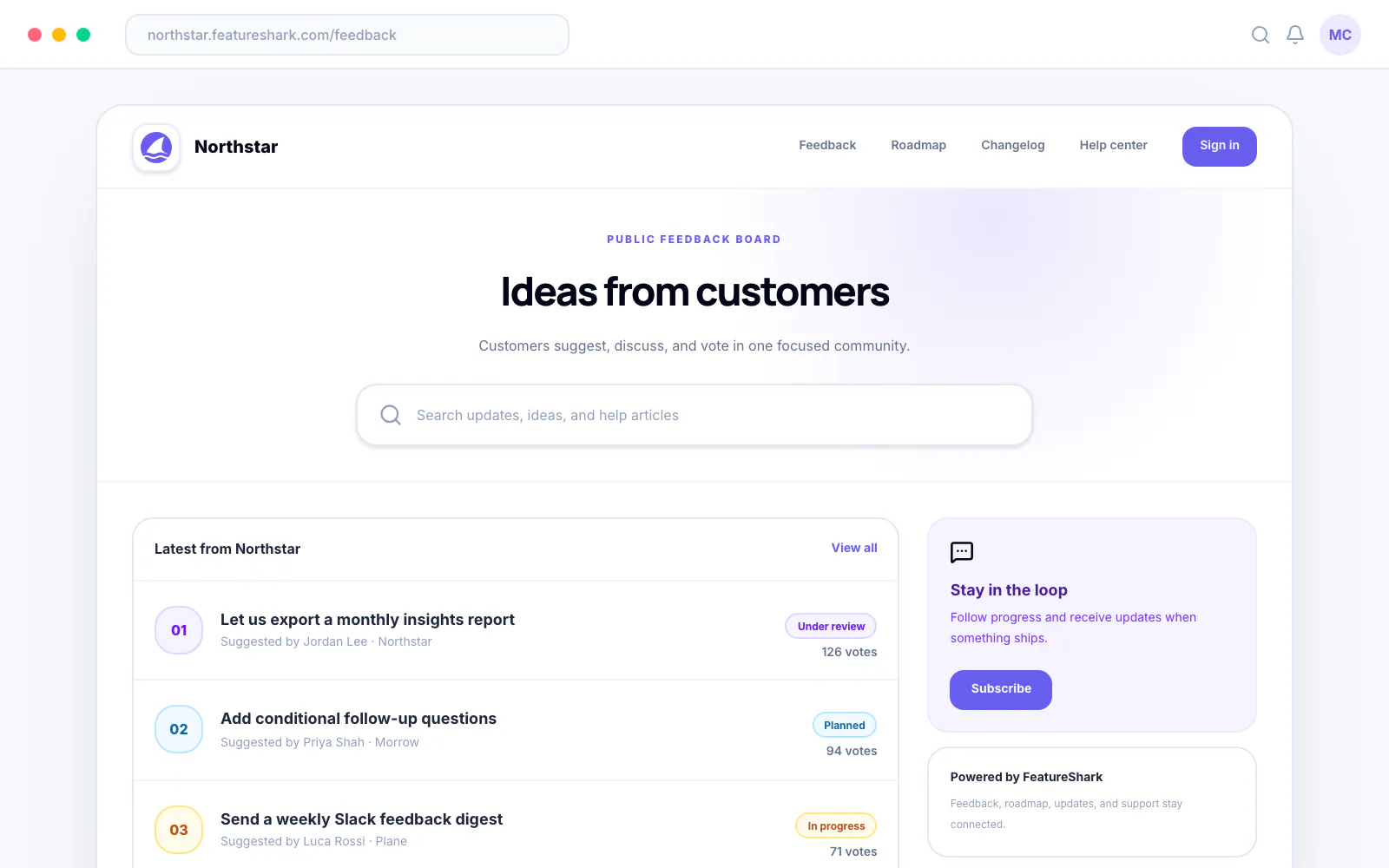
A purpose-built customer feedback tool addresses every weakness of spreadsheets:
| Capability | Spreadsheet | Customer Feedback Tool |
|---|---|---|
| Multi-channel collection | Manual copy-paste | Automatic from widgets, email, Slack |
| Duplicate detection | Manual search | Automated merging |
| User voting | Not possible | Built-in upvoting |
| Prioritization | Subjective columns | RICE scoring, impact analysis |
| Public roadmap | Separate document | Integrated and auto-updated |
| Status notifications | Manual emails | Automatic user updates |
| Integrations | Zapier workarounds | Native Slack, Jira, Linear |
| Reporting | Manual pivot tables | Real-time dashboards |
The difference isn't marginal — it's a completely different category of capability.
The Real Cost of Spreadsheets
"But spreadsheets are free!" — sure, the software is. But the hidden costs add up fast:
Time Cost
A PM spending 5 hours per week managing a feedback spreadsheet costs:
- 5 hours × $75/hour × 52 weeks = $19,500/year in lost productivity
That's money spent on data entry instead of product strategy.
Opportunity Cost
Without proper prioritization, you're likely building the wrong features. One misallocated sprint (2 weeks of engineering time for a 4-person team) can cost $40,000+ in wasted effort.
Churn Cost
When users feel unheard, they leave. Even a 2% increase in churn from poor feedback management can dwarf the cost of a dedicated tool.
When to Make the Switch
You don't need to switch on day one. But if any of these are true, it's time:
- You have more than 50 active users giving feedback
- Feedback comes in from 3+ channels (email, Slack, in-app, support)
- Your PM spends more than 2 hours/week organizing feedback
- Users ask "what happened to my request?" and you don't have a good answer
- You're about to plan a major product cycle and need clear priorities
How to Migrate From Spreadsheets
Switching doesn't have to be painful. Here's a practical migration path:
Step 1: Export Your Existing Data
Export your spreadsheet to CSV. Most feedback tools, including FeatureShark, support CSV import to bring your existing data along.
Step 2: Set Up Collection Channels
Install the feedback collection widget in your app and configure email forwarding. This ensures new feedback flows automatically — no more manual entry.
Step 3: Enable Voting
Create a public feedback board and invite your existing users to vote on the requests you imported. Within a week, you'll have real prioritization data.
Step 4: Connect Your Roadmap
Link your feedback board to a public roadmap so users can see what's planned, in progress, and shipped.
Step 5: Archive the Spreadsheet
Once all data is migrated and new feedback is flowing through the tool, archive the spreadsheet. Don't look back.
Choosing the Right Tool
Not all feedback tools are equal. Read our detailed guide on how to choose the right customer feedback tool for a full checklist. You can also compare top options in our Best Customer Feedback Tools for SaaS roundup.
Key things to look for:
- Free plan to get started (FeatureShark has one)
- In-app widget that embeds in minutes
- Public voting board
- Built-in roadmap
- Integrations with Slack, Jira, and your support tools
Get Started Today
If you're ready to switch from spreadsheets to a proper customer feedback tool, FeatureShark is the fastest way to get started.
You'll have a feedback board live in under 10 minutes, with a free plan that includes unlimited feedback items, voting, and a public roadmap. No credit card required.
Start collecting feedback for free →
Related Reading
- Customer Feedback Tool — Solutions Overview
- How to Choose the Right Customer Feedback Tool
- Customer Feedback Software: The Ultimate Guide
- Explore All Features
Related Guides
- How to Choose the Right Customer Feedback Tool in 2026
- FeatureShark vs Featurebase: Per-Seat Pricing vs Flat Rate — Which Feedback Platform Wins in 2026?
- FeatureShark vs UserVoice: Enterprise Pricing vs Startup-Friendly Feedback in 2026
- FeatureShark vs Productboard: Why Pay Enterprise Prices for Feedback Management in 2026?
Sources and Further Reading
About this article
Written by FeatureShark Team
FeatureShark publishes practical product-management guidance based on the workflows we build for feedback, roadmaps, changelogs, support, surveys, and AI-assisted product operations. We update articles when the underlying guidance changes.
Put the workflow into practice.
Use FeatureShark to connect customer feedback, roadmap evidence, release communication, support, and surveys in one lifecycle.
Start free