

Article summary
Discover everything you need to know about customer feedback software, from choosing the right tools to implementing best practices that drive product success and customer satisfaction.
Table of contents
- What is Customer Feedback Software?
- Why Customer Feedback is Important
- How to Collect Customer Feedback Effectively
- Types of Customer Feedback
- Best Customer Feedback Software: Key Features to Look For
- How to Track Customer Feedback at Scale
- How to Ask for Customer Feedback (Without Being Annoying)
- How to Use Customer Feedback to Drive Product Success
- Customer Feedback Management Platform Comparison
- How to Get Customer Feedback Online: Digital Strategies
- Customer Feedback Systems: Building Your Tech Stack
- Customer Feedback Meaning: Beyond the Basics
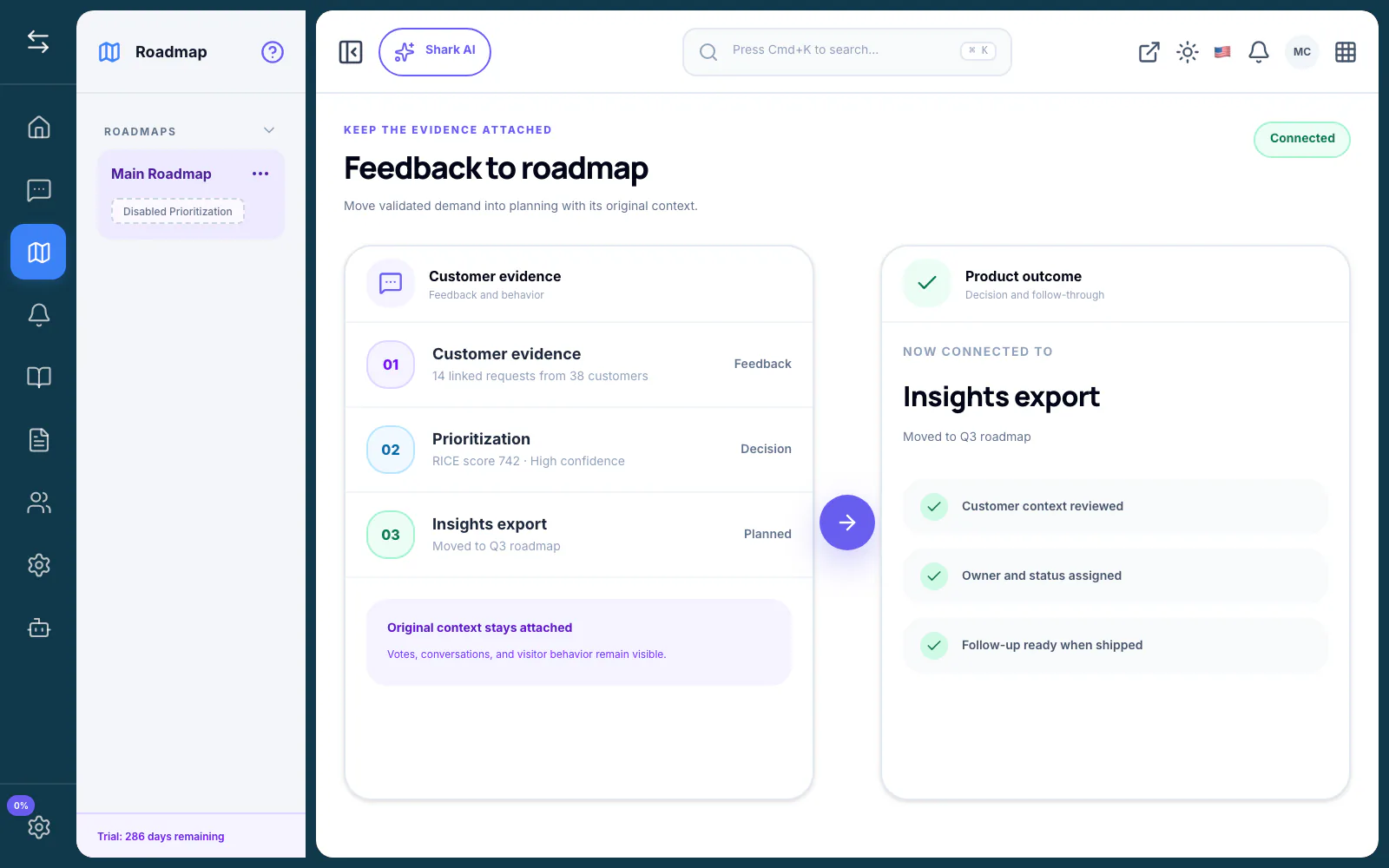
This guide explains customer feedback software the 2025 with practical steps, tradeoffs, and examples. The practical goal is to preserve customer context, combine duplicate signals, and move the strongest evidence into a decision your team can explain.
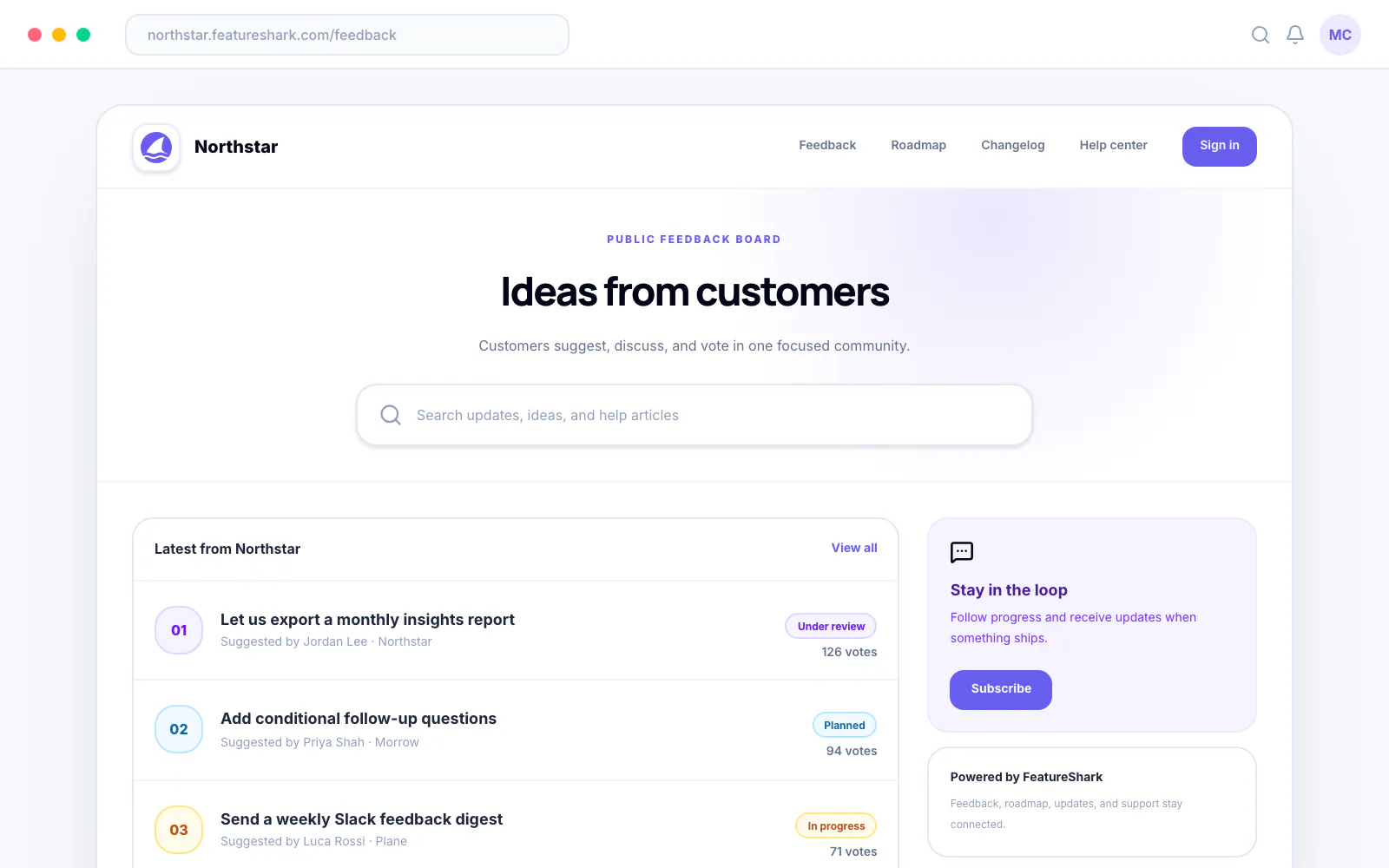
What is Customer Feedback Software?
Customer feedback software is a specialized platform designed to help businesses systematically collect, analyze, and act on feedback from their customers. These tools go far beyond simple survey forms, offering sophisticated features for managing the entire feedback lifecycle.
Modern customer feedback platforms typically include:
- Multiple collection channels (in-app widgets, email surveys, feedback forms)
- Organization and categorization of feedback by topic, priority, or customer segment
- Voting and prioritization systems to understand demand
- Analytics and reporting to identify trends and patterns
- Integration capabilities with your existing tech stack
- Workflow automation to ensure feedback doesn't fall through the cracks
For a deep dive on closing the loop with customers, see our customer feedback loop guide. Also explore feedback prioritization frameworks to learn how to rank feature requests.
According to recent research by Gartner, companies that actively collect and act on customer feedback see 15-20% higher customer retention rates compared to those that don't. The right software makes this process scalable and efficient.
Why Customer Feedback is Important
Before diving into software solutions, let's understand why customer feedback matters so much:
1. Product-Market Fit
Customer feedback is your most reliable indicator of product-market fit. When customers tell you what they need, what frustrates them, and what delights them, you gain invaluable insights that no amount of internal brainstorming can match.
Companies like Slack and Notion built their success by obsessively listening to customer feedback during their early days. Slack's CEO, Stewart Butterfield, famously said: "We built Slack by listening to what users needed, not what we thought they wanted."
2. Customer Retention and Loyalty
Customers who feel heard are more likely to stay with your product. A study by Microsoft found that 77% of customers view brands more favorably when they actively seek out and accept customer feedback.
When you implement features or improvements based on customer suggestions and then notify those customers about the changes, you create powerful advocates for your brand.
3. Competitive Advantage
Understanding your customers better than competitors do creates a sustainable competitive advantage. While competitors guess about market needs, you can make data-driven decisions based on real customer input.
4. Reduced Churn
Obtaining customer feedback proactively helps you identify at-risk customers before they churn. When customers express frustration or report problems, you have an opportunity to address issues and save the relationship. Learn effective strategies in our churn feedback guide.
Research by Bain & Company shows that increasing customer retention rates by just 5% can increase profits by 25-95%.
5. Innovation Direction
The best product innovations often come from customer insights. Your customers are using your product in real-world scenarios and can identify opportunities for improvement that your team might never consider.
How to Collect Customer Feedback Effectively
Understanding how to collect customer feedback is crucial for success. Here are the most effective methods:
1. In-App Feedback Widgets
Best for: Real-time product feedback, feature requests, bug reports
In-app widgets allow customers to submit feedback without leaving your product. This reduces friction and increases response rates. Modern feedback widgets can be triggered contextually, appearing at the right moment in the user journey. See our complete in-app feedback guide for implementation strategies.
Implementation tip: Place feedback widgets strategically throughout your application, especially in areas where users might encounter friction or after they complete key actions.
2. Email Surveys
Best for: Detailed insights, customer satisfaction measurement (CSAT, NPS)
Email surveys remain highly effective for gathering detailed feedback. The key is timing and relevance—send surveys after specific interactions or milestones.
Best practices:
- Keep surveys short (5-7 questions maximum)
- Use a mix of quantitative and qualitative questions
- Send surveys at logical points in the customer journey
- Always follow up on survey responses
3. Customer Interviews
Best for: Deep insights, understanding motivations, exploratory research
One-on-one interviews provide rich, qualitative data that surveys can't capture. While time-intensive, interviews help you understand the "why" behind customer behavior.
Pro tip: Interview your most engaged customers AND recently churned customers to get a complete picture.
4. Feature Voting Boards
Best for: Prioritizing development, engaging your community
Public feature voting boards serve dual purposes: collecting ideas and helping you prioritize development based on demand. They also increase transparency and customer engagement.
FeatureShark excels at this: Our feedback collection tools combine voting, commenting, and impact analysis to help you make data-driven prioritization decisions.
5. Support Ticket Analysis
Best for: Identifying pain points, recurring issues
Your support tickets contain a goldmine of feedback. Analyzing common issues, feature requests, and questions reveals patterns that should influence your roadmap.
6. Social Media Listening
Best for: Unfiltered opinions, brand perception, competitive insights
Monitor mentions of your brand on social media platforms. Customers often share candid feedback on Twitter, LinkedIn, and Facebook that they might not submit through formal channels.
7. Website Exit Surveys
Best for: Understanding why visitors don't convert
Exit-intent popups can capture feedback from visitors who are about to leave without converting. Ask what prevented them from signing up or making a purchase.
Types of Customer Feedback
Understanding the types of customer feedback helps you collect the right information at the right time:
1. Product Feedback
Direct input about your product's features, functionality, and user experience. This includes:
- Feature requests
- Bug reports
- Usability issues
- Performance concerns
How to collect: In-app feedback widgets, user testing sessions, feature voting boards
2. Customer Service Feedback
Feedback about support interactions and customer service quality:
- Response time satisfaction
- Issue resolution effectiveness
- Support agent helpfulness
- Self-service resource quality
How to collect: Post-interaction surveys, CSAT scores, support ticket follow-ups
3. Customer Satisfaction (CSAT) Feedback
Measures overall satisfaction with your product or specific interactions:
- Overall satisfaction ratings
- Likelihood to recommend (Net Promoter Score)
- Product value perception
- Satisfaction with recent updates
How to collect: Periodic satisfaction surveys, NPS campaigns, milestone surveys
4. Customer Effort Score (CES) Feedback
Measures how easy it is for customers to accomplish tasks:
- Ease of onboarding
- Difficulty of specific workflows
- Self-service effectiveness
- Support accessibility
How to collect: Post-task surveys, onboarding surveys, after support interactions
5. Competitive Feedback
Insights about how you compare to alternatives:
- Comparison with competitors
- Reasons for choosing your product
- Features competitors offer that you don't
- Why customers leave for competitors
How to collect: Win/loss interviews, churn surveys, competitive feature questions
6. Strategic Feedback
High-level input about business direction:
- Market positioning
- Pricing perception
- Brand image
- Long-term product vision alignment
How to collect: Advisory board meetings, executive customer interviews, strategic surveys
Best Customer Feedback Software: Key Features to Look For
When evaluating customer feedback management platforms, prioritize these essential features:
1. Multi-Channel Feedback Collection
Your customer feedback system should collect feedback from multiple sources:
- In-app widgets
- Email and web forms
- API integrations
- Social media connections
- Support ticket imports
Why it matters: Customers provide feedback through various channels. Centralizing all feedback in one system ensures nothing gets lost.
2. Intelligent Organization and Categorization
Look for systems that can:
- Automatically categorize feedback by topic
- Tag feedback with custom labels
- Link related feedback items
- Merge duplicate submissions
- Use AI to identify themes and patterns
Why it matters: As feedback volume grows, manual organization becomes impossible. Smart automation keeps everything organized.
3. Prioritization and Voting
The best customer feedback software includes:
- Public voting systems
- Internal prioritization frameworks
- Impact scoring
- Customer segment weighting
- Integration with product roadmaps
Why it matters: Not all feedback is equally important. Prioritization tools help you focus on what matters most.
4. Customer Communication Tools
Your feedback platform should facilitate:
- Status updates to customers
- Automated notifications
- Public roadmaps
- Changelog announcements
- Direct customer responses
Why it matters: Getting customer feedback is only valuable if you close the loop. Customers need to know their input matters.
5. Analytics and Reporting
Robust analytics should include:
- Feedback trends over time
- Customer segment analysis
- Feature request popularity
- Satisfaction metrics
- Custom report builders
Why it matters: Data-driven decisions require comprehensive analytics. Look for platforms that help you identify patterns and measure impact.
6. Integration Capabilities
Your customer feedback system should integrate with:
- Development tools (GitHub, Jira, Linear)
- Communication platforms (Slack, Microsoft Teams)
- CRM systems (Salesforce, HubSpot)
- Analytics tools (Mixpanel, Amplitude)
- Support platforms (Zendesk, Intercom)
Why it matters: Feedback needs to flow seamlessly into your existing workflows. Integrations eliminate manual data transfer.
7. Customization and Branding
Look for platforms that offer:
- Custom domain options
- Brand color and logo customization
- White-label capabilities
- Custom email templates
- Flexible widget styling
Why it matters: Your feedback portal represents your brand. It should look and feel like a natural extension of your product.
8. Security and Privacy
Essential security features include:
- SOC 2 compliance
- GDPR compliance
- SSO support
- Role-based access control
- Data encryption
Why it matters: Customer feedback often contains sensitive information. Security cannot be compromised.
How to Track Customer Feedback at Scale
Understanding how to track customer feedback effectively becomes crucial as your business grows. Here's a framework for scaling feedback management:
Stage 1: Getting Started (0-100 Feedback Items)
Tools needed: Basic feedback form, spreadsheet for tracking
Process:
- Set up a simple feedback collection form
- Manually review all feedback
- Respond personally to each submission
- Track in a spreadsheet with columns for priority, category, and status
Key focus: Building the habit of collecting and responding to feedback
Stage 2: Systematizing (100-1,000 Feedback Items)
Tools needed: Dedicated feedback software with categorization and voting
Process:
- Implement a proper customer feedback management platform
- Create categories and tags for organization
- Enable public voting to gauge demand
- Set up weekly review meetings
- Connect feedback to your roadmap
Key focus: Creating sustainable processes that don't require constant manual effort
Stage 3: Optimizing (1,000+ Feedback Items)
Tools needed: Advanced feedback platform with AI, automation, and analytics
Process:
- Use AI-powered categorization and sentiment analysis
- Implement automated workflows and notifications
- Create customer segments for weighted prioritization
- Build detailed analytics dashboards
- Integrate deeply with product development tools
Key focus: Data-driven decision making and automated workflows
FeatureShark is built for all stages: Whether you're just starting out or managing thousands of feedback items, our platform scales with you. Learn more about our comprehensive feedback management solution.
How to Ask for Customer Feedback (Without Being Annoying)
Knowing how to ask customer feedback effectively is an art. Here are proven strategies:
1. Timing is Everything
Bad timing: Asking for feedback during a trial period or immediately after signup
Good timing:
- After customers achieve a key milestone
- Following successful support interactions
- When customers demonstrate engagement (multiple sessions, key feature usage)
- After product updates that address their pain points
2. Make It Easy
Bad approach: Long surveys with 20+ questions
Good approach:
- Start with one key question
- Use progressive disclosure (ask follow-up questions based on responses)
- Offer one-click ratings with optional detailed feedback
- Use in-app widgets that don't require navigation
3. Explain the Value
Bad request: "Please fill out this survey"
Good request: "Help us improve [specific feature] by sharing your experience. Your feedback directly influences our roadmap, and we'll notify you when we implement your suggestions."
4. Offer Incentives (Carefully)
Bad incentive: Generic gift cards for all feedback
Good incentive:
- Early access to features they requested
- Priority support for active feedback contributors
- Public recognition in release notes
- Exclusive beta tester opportunities
5. Close the Loop
Bad follow-up: No response or generic "thank you"
Good follow-up:
- Personalized acknowledgment within 24 hours
- Status updates as feedback progresses
- Personal notification when their suggestion is implemented
- Recognition in changelog or release notes
6. Respect Their Time
Bad practice: Frequent, repetitive survey requests
Good practice:
- Limit survey frequency (no more than once per quarter per customer)
- Use smart targeting (only ask relevant questions based on usage)
- Allow customers to opt out of specific survey types
- Remember previous feedback to avoid repetition
How to Use Customer Feedback to Drive Product Success
Collecting feedback is just the beginning. Here's how to use customer feedback effectively:
1. Establish a Regular Review Cadence
Set up weekly or bi-weekly feedback review sessions with your product team:
Meeting structure:
- Review new high-priority feedback (15 minutes)
- Discuss trending topics and patterns (15 minutes)
- Make prioritization decisions (20 minutes)
- Assign action items and owners (10 minutes)
2. Create a Scoring Framework
Develop a consistent scoring system for prioritizing feedback. Learn more about feedback prioritization frameworks.
Example scoring framework:
- Impact: How many customers does this affect? (1-10)
- Business value: How does this align with business goals? (1-10)
- Effort: How much resources will this require? (1-10, lower is better)
- Strategic fit: How well does this fit our product vision? (1-10)
Priority score: (Impact + Business Value + Strategic Fit) / Effort
3. Connect Feedback to Customer Value
Weight feedback based on customer characteristics:
Weighting factors:
- Customer plan level (Enterprise > Pro > Free)
- Account age and engagement
- Total contract value
- Strategic importance
- Influence (thought leaders, large audiences)
This ensures you're building for customers who drive the most value.
4. Look for Patterns, Not Individual Requests
One customer asking for a specific feature doesn't necessarily indicate demand. Look for:
- Multiple customers describing the same pain point (even if solutions differ)
- Feedback from different customer segments experiencing similar issues
- Alignment between feedback and usage data
- Correlation with churn or expansion patterns
5. Validate Before Building
Before committing resources to a large feature:
Validation steps:
- Create a detailed specification based on feedback
- Share with customers who requested it for validation
- Estimate the total addressable market for the feature
- Consider alternative solutions that might address the underlying need
- Build a lightweight prototype or proof of concept if possible
6. Communicate Decisions Transparently
Whether you decide to build, defer, or decline feedback:
What to communicate:
- Build: Add to roadmap, provide timeline estimates, invite to beta
- Defer: Explain why it's not a current priority, add to long-term roadmap
- Decline: Respectfully explain why it doesn't align with product vision
Example decline message: "Thank you for this thoughtful suggestion. While we can see the value, we've decided not to pursue this feature because it would require significant changes to our core architecture and would primarily benefit a small segment of users. Instead, we're focusing on [alternative solution] which addresses similar needs in a way that benefits more customers."
Learn more about effective feedback management in our guide on how to manage customer feedback. Also see our feedback response templates for communication best practices.
Customer Feedback Management Platform Comparison
Let's compare the best customer feedback software options available in 2025:
FeatureShark - Best Overall
Pricing: $9-49/month (Free tier available)
Best for: SaaS companies, product teams, startups
Key strengths:
- All-in-one platform (feedback, roadmap, changelog, help center, support, surveys)
- AI-powered prioritization and categorization
- Beautiful, customizable interface
- Excellent integration ecosystem
- Outstanding value for money
- Built-in analytics and reporting
Why it's #1: FeatureShark offers enterprise-level features at startup-friendly prices. The unified platform eliminates tool sprawl, while AI automation saves countless hours of manual work.
Explore FeatureShark's features or start your free trial.
Canny - Good for Established Companies
Pricing: $50-400+/month
Best for: Established companies with dedicated product teams
See our detailed Canny vs FeatureShark comparison for an in-depth analysis.
Key strengths:
- Mature platform with proven track record
- Public and private boards
- Good roadmap functionality
- Reliable uptime
Limitations:
- Higher pricing
- Limited advanced features
- Basic analytics
- No built-in help center or support tools
Productboard - Enterprise Solution
Pricing: Custom (typically $100-500+/month)
Best for: Large enterprises with complex needs
Key strengths:
- Sophisticated prioritization frameworks
- Deep integration with enterprise tools
- Comprehensive roadmapping
- Advanced analytics
Limitations:
- Expensive
- Steep learning curve
- Overkill for small teams
- Long setup time
UserVoice - Legacy Platform
Pricing: $499-999+/month
Best for: Large companies already invested in the platform
Key strengths:
- Established presence
- Enterprise features
- Comprehensive tools
Limitations:
- Very expensive
- Dated interface
- Limited innovation
- Better alternatives available
Aha! - Product Management Suite
Pricing: $59-149 per user/month
Best for: Product teams needing comprehensive PM tools
Key strengths:
- Full product management suite
- Strong roadmapping features
- Good strategic planning tools
Limitations:
- Expensive for feedback-focused use
- Complex for simple needs
- Per-user pricing gets costly
- Feedback is one small part of larger suite
How to Get Customer Feedback Online: Digital Strategies
Understanding how to get customer feedback online is essential in our digital-first world. Here are proven strategies:
1. Embed Feedback Everywhere
Strategic placements:
- Footer of every page ("Have feedback? Let us know")
- Settings or profile pages
- After key actions (completing a task, exporting data)
- In empty states ("What features would you like to see here?")
- Error pages ("Help us improve by reporting this issue")
2. Leverage Email Signatures
Add feedback links to team email signatures:
Example: "Have feedback about [Product]? [Share your thoughts here]"
This passive collection method reaches customers during natural communication.
3. Use Exit Intent Popups
When visitors show intent to leave:
- Ask why they're not signing up
- Offer to address concerns
- Request feature information they're looking for
- Capture competitive intel ("Are you evaluating alternatives?")
4. Social Media Engagement
Proactive strategies:
- Create Twitter threads asking specific questions
- Run LinkedIn polls on feature priorities
- Host Reddit AMAs in relevant communities
- Use Instagram Stories polls and questions
- Create Facebook community groups for power users
5. In-Product Prompts
Contextual prompts based on user behavior:
- After using a feature 10+ times ("You seem to love this feature! What could make it better?")
- When users encounter friction ("We noticed you had trouble with X. How can we improve?")
- When users discover new features ("What do you think of this new feature?")
- After long sessions ("You've been busy! How's your experience going?")
6. Documentation Feedback
Add feedback options to documentation:
- "Was this article helpful?" ratings
- "What information is missing?" questions
- Quick feedback buttons throughout docs
- Video tutorial feedback forms
7. Community Forums
Getting feedback from customers through community forums provides rich insights:
- Create dedicated feature request categories
- Monitor discussions for pain points
- Engage with community suggestions
- Recognize valuable contributors
Pro tip: FeatureShark includes community features built-in, combining forums, voting, and roadmaps in one place. Learn more about our community feedback tools.
Customer Feedback Systems: Building Your Tech Stack
Creating effective customer feedback systems requires thoughtful integration of tools and processes:
Essential Components
1. Collection Layer
- Feedback widgets and forms
- Survey tools
- Email collection
- Social listening
- Support ticket integration
2. Organization Layer
- Categorization and tagging
- Deduplication
- Sentiment analysis
- Trend identification
- Customer segment association
3. Analysis Layer
- Prioritization frameworks
- Impact scoring
- Analytics and reporting
- Trend analysis
- Correlation with business metrics
4. Action Layer
- Integration with product development tools
- Roadmap connection
- Automated workflows
- Notification systems
- Status update distribution
5. Communication Layer
- Customer notifications
- Public roadmaps
- Changelog announcements
- Email updates
- In-app messaging
Integration Architecture
Option 1: Best-of-Breed Approach
Combine specialized tools:
- Feedback: Dedicated feedback platform
- Surveys: Typeform or SurveyMonkey
- Analytics: Mixpanel or Amplitude
- Project Management: Jira or Linear
- Communication: Intercom or Customer.io
Pros: Specialized tools excel at their specific function Cons: Integration complexity, data silos, higher total cost
Option 2: Unified Platform Approach
Use an all-in-one solution like FeatureShark:
- All tools in one platform
- Seamless data flow
- Single source of truth
- Simplified management
- Better cost efficiency
Pros: Simplicity, integration, cost-effective, unified data Cons: Less specialization in individual areas (though modern unified platforms like FeatureShark have largely eliminated this drawback)
Recommendation: For most companies, especially startups and scale-ups, a unified platform provides the best balance of capabilities, simplicity, and cost. Enterprise companies with very specific needs might benefit from best-of-breed approaches, but should carefully consider integration complexity.
Customer Feedback Meaning: Beyond the Basics
Understanding the true customer feedback meaning requires looking deeper than surface-level requests:
What Customers Say vs. What They Mean
Customer says: "I want a dark mode" What they mean: "I work late at night and the bright interface hurts my eyes" Better solution: Automatic theme switching based on system preferences OR ambient light detection
Customer says: "Add integration with [obscure tool]" What they mean: "I need to get data from your product into my workflow" Better solution: Zapier integration or API that works with hundreds of tools
Customer says: "Make it faster" What they mean: Various things - perception of speed, actual load times, workflow efficiency Better solution: Investigate which specific interactions feel slow and optimize those
Reading Between the Lines
Feedback analysis techniques:
-
Jobs to Be Done Framework
- What job is the customer trying to accomplish?
- What outcome are they seeking?
- What barriers prevent them from achieving this?
-
Pain vs. Gain Analysis
- Is this feedback about avoiding pain or seeking gain?
- Pain-focused feedback often indicates critical issues
- Gain-focused feedback suggests enhancement opportunities
-
Frequency and Intensity
- How often does this issue occur?
- How strongly do customers feel about it?
- High frequency + high intensity = priority
-
Workaround Detection
- Are customers creating workarounds for missing functionality?
- Workarounds indicate both need and friction
- Elegant workarounds might inspire better solutions
Sentiment and Emotion
Obtaining customer feedback includes understanding emotional context:
Positive sentiment indicators:
- Enthusiastic language ("love," "amazing," "game-changer")
- Detailed suggestions (they care enough to think deeply)
- Proactive sharing (unprompted positive feedback)
- Advocacy (recommending to others)
Negative sentiment indicators:
- Frustrated language ("annoying," "broken," "waste of time")
- Comparison to competitors ("X has this, why don't you?")
- Considering alternatives ("might need to look elsewhere")
- Short, terse feedback (exhausted with the issue)
Neutral sentiment indicators:
- Factual, unemotional language
- Specific, technical descriptions
- Process-improvement focused
- Constructive tone
Modern customer feedback software uses AI to automatically detect sentiment, helping you prioritize responses and identify at-risk customers.
Implementing Your Customer Feedback Strategy
Ready to transform how you manage customer feedback? Here's your implementation roadmap:
Phase 1: Foundation (Weeks 1-2)
Goal: Set up basic feedback collection
Actions:
- Choose your customer feedback management platform (we recommend FeatureShark)
- Set up collection channels (in-app widget, email form, website)
- Define basic categories and tags
- Configure integrations with existing tools
- Train team members on the platform
Success metrics:
- Feedback collection active
- Team comfortable with platform
- Basic categorization working
Phase 2: Systematization (Weeks 3-4)
Goal: Establish consistent processes
Actions:
- Create feedback review cadence (weekly meetings)
- Develop prioritization framework
- Set up automation workflows
- Enable public roadmap
- Create response templates for common scenarios
Success metrics:
- Regular review meetings occurring
- Feedback being prioritized consistently
- Customers receiving responses
Phase 3: Optimization (Weeks 5-8)
Goal: Refine and improve processes
Actions:
- Analyze feedback trends and patterns
- Implement AI-powered features (auto-categorization, sentiment analysis)
- Set up advanced analytics dashboards
- Create customer segments for weighted prioritization
- Optimize feedback collection placements
Success metrics:
- Feedback volume increasing
- Response time decreasing
- Patterns being identified
- Product decisions informed by feedback
Phase 4: Integration (Weeks 9-12)
Goal: Deeply integrate feedback into product development
Actions:
- Connect feedback directly to development workflows
- Implement automated roadmap updates
- Set up customer notification systems
- Create changelog automated from feedback
- Establish feedback-driven OKRs
Success metrics:
- Feedback driving roadmap decisions
- Customers notified of implementations
- Reduced churn from listening
- Increased engagement with feedback system
Phase 5: Continuous Improvement (Ongoing)
Goal: Continuously evolve your feedback strategy
Actions:
- Regular strategy reviews (quarterly)
- Experiment with new collection methods
- Refine prioritization criteria
- Expand automation
- Measure business impact
Success metrics:
- Increasing customer satisfaction
- Feedback-driven features showing impact
- Team confidence in prioritization decisions
- Competitive advantage from customer insights
Measuring the Impact of Customer Feedback
How do you know if your customer feedback system is working? Track these metrics:
Input Metrics
Feedback volume:
- Total feedback submissions per month
- Feedback per active customer (penetration rate)
- Feedback sources (which channels are most effective)
- Feedback quality scores
Target: 5-10% of active customers providing feedback monthly
Process Metrics
Response efficiency:
- Average time to first response
- Percentage of feedback acknowledged within 24 hours
- Average time from submission to resolution
- Team utilization rates
Target: 90% of feedback acknowledged within 24 hours
Output Metrics
Product impact:
- Percentage of features built from customer feedback
- Customer satisfaction with implemented features
- Engagement with feedback-driven features vs. internally conceived features
- Velocity of feature releases
Target: 60-80% of features influenced by customer feedback
Business Metrics
Customer impact:
- Net Promoter Score (NPS) trends
- Customer retention rate
- Churn reduction among feedback contributors
- Expansion revenue from feedback-engaged customers
- Customer lifetime value of engaged customers vs. non-engaged
Target: 20-30% higher retention among feedback contributors
Engagement Metrics
Community health:
- Active feedback contributors
- Voting participation rate
- Discussion engagement
- Public roadmap views
- Changelog engagement
Target: 15-25% of customers engaging with feedback tools
Common Mistakes to Avoid
Learn from these common pitfalls in customer feedback management:
1. Collecting Without Acting
The mistake: Gathering feedback but never implementing it
The impact: Customers feel ignored, stop providing feedback, churn increases
The fix: Implement a regular review process and commit to acting on prioritized feedback. Better to collect less feedback and act on it than collect everything and do nothing.
2. Building Everything Requested
The mistake: Treating feedback as requirements
The impact: Product loses focus, becomes bloated, tries to serve everyone poorly
The fix: Use feedback to identify problems, but design your own solutions. Not every request should be built as specified.
3. Only Listening to Loud Voices
The mistake: Prioritizing feedback from the most vocal customers
The impact: Silent majority underserved, product optimized for edge cases
The fix: Weight feedback by customer value and segment. Actively seek input from quiet but important customers.
4. Ignoring Context
The mistake: Taking feedback at face value without understanding context
The impact: Solutions that miss the mark, wasted development effort
The fix: Always ask "why" and understand the job the customer is trying to accomplish. Dig deeper into motivations.
5. Poor Communication
The mistake: Failing to close the loop with customers
The impact: Customers don't know their feedback matters, engagement drops
The fix: Always respond to feedback, provide status updates, and personally notify customers when their requests are implemented.
6. Analysis Paralysis
The mistake: Endlessly analyzing feedback without making decisions
The impact: Slow product evolution, missed opportunities, frustrated team
The fix: Set decision deadlines, use good-enough prioritization frameworks, iterate and learn.
7. Tool Overload
The mistake: Using too many disconnected tools for feedback management
The impact: Data silos, manual work, things falling through cracks
The fix: Consolidate into a unified platform like FeatureShark that handles the entire feedback lifecycle.
Learn more about avoiding these mistakes in our feature management best practices guide.
The Future of Customer Feedback Software
As we look ahead, several trends are shaping the future of customer feedback systems:
1. AI-Powered Intelligence
AI is transforming feedback management:
- Automatic categorization with 95%+ accuracy
- Sentiment analysis detecting emotional context
- Trend prediction identifying emerging patterns before they're obvious
- Smart prioritization suggesting which feedback to act on
- Response generation drafting replies automatically
FeatureShark's AI features already incorporate many of these capabilities, with more coming in 2025.
2. Predictive Analytics
Future systems will predict:
- Which customers are likely to churn based on feedback patterns
- Which features will drive the most engagement before they're built
- Which customer segments will value specific improvements most
- What feedback a customer is likely to provide based on usage patterns
3. Deeper Integration
Feedback platforms will integrate more deeply with:
- Product analytics (correlating feedback with usage data automatically)
- Revenue data (connecting feedback to business outcomes)
- Customer success platforms (triggering interventions based on feedback)
- Development tools (auto-creating tickets from prioritized feedback)
4. Proactive Feedback Collection
Systems will automatically:
- Trigger surveys at optimal moments
- Identify confused users and offer help
- Detect frustration and collect feedback
- Celebrate positive moments and capture testimonials
5. Real-Time Adaptation
Products will evolve based on feedback in real-time:
- A/B testing automatically deployed based on feedback
- Feature flags controlled by feedback sentiment
- Personalized experiences informed by individual feedback
- Dynamic roadmap prioritization based on current feedback trends
6. Voice and Video Feedback
Moving beyond text:
- Voice notes for detailed feedback
- Screen recordings showing exact issues
- Video testimonials for positive feedback
- Emotion detection from voice analysis
7. Community-Driven Development
Stronger community involvement:
- Community members voting on priorities
- Transparent public roadmaps as default
- Customer co-creation of features
- Beta testing communities built into platforms
FeatureShark is leading this evolution: Our platform already includes many of these forward-looking features, with a roadmap focused on staying ahead of industry trends. See what we're building next.
Conclusion: Transform Your Product with Customer Feedback
The right customer feedback software is more than just a tool—it's a competitive advantage that can transform your product and business.
By systematically collecting customer feedback, organizing it intelligently, prioritizing strategically, and acting decisively, you can:
- Build better products that customers actually want
- Increase customer satisfaction and loyalty
- Reduce churn by addressing issues proactively
- Accelerate growth through word-of-mouth from happy customers
- Make confident decisions backed by customer data
- Create competitive advantages through deeper customer understanding
The question isn't whether you should invest in customer feedback management—it's how quickly you can implement a system that works.
Ready to Transform Your Feedback Management?
FeatureShark provides everything you need:
✅ Multi-channel feedback collection that meets customers where they are ✅ AI-powered organization that saves hours of manual work ✅ Smart prioritization that helps you build what matters most ✅ Public roadmaps that build trust and transparency ✅ Integrated analytics for data-driven decisions ✅ Seamless integrations with your existing tools ✅ All-in-one platform that eliminates tool sprawl
Start your free 14-day trial today and experience the difference a purpose-built customer feedback management platform can make.
Or schedule a demo to see how FeatureShark can transform your product development process.
Frequently Asked Questions
What is the best customer feedback software?
FeatureShark is the best customer feedback software for most SaaS companies and product teams because it combines powerful features with exceptional ease of use and value. It includes feedback collection, roadmaps, changelog, help center, support, and surveys in one unified platform with AI-powered automation.
How much does customer feedback software cost?
Customer feedback software typically ranges from free tiers to $500+/month. FeatureShark offers exceptional value starting at just $9/month with a generous free tier, while competitors like Canny start at $50/month and enterprise solutions like UserVoice cost $500+/month.
How do I get started with customer feedback?
Start by choosing a customer feedback platform (we recommend FeatureShark), setting up collection channels (in-app widget, email), defining basic categories, and establishing a regular review process. Most importantly, commit to responding to feedback and closing the loop with customers.
What's the difference between customer feedback and feature requests?
Customer feedback is a broad term encompassing all input from customers, including satisfaction ratings, bug reports, general comments, and suggestions. Feature requests are a specific type of feedback where customers suggest new functionality or improvements. Feature requests are a subset of overall customer feedback.
How often should I collect customer feedback?
Collect feedback continuously through always-available channels (in-app widgets, contact forms), but limit proactive requests (surveys, emails) to no more than once per quarter per customer. The key is making feedback collection frictionless while respecting customers' time.
Should feedback be anonymous or attributed?
Both have value. Attributed feedback allows for follow-up questions and provides context about the customer's segment and value. Anonymous feedback can yield more honest input about sensitive topics. Most customer feedback systems should default to attributed but offer anonymous options.
How do I prioritize conflicting feedback?
Use a structured prioritization framework that considers: (1) Impact (how many customers affected), (2) Business value (alignment with goals), (3) Effort (resources required), and (4) Strategic fit (product vision alignment). Weight feedback by customer value and segment importance. Remember that some conflicts can be resolved through user preferences or settings.
Want to learn more about building exceptional products? Check out our guides on how to collect customer feedback and managing customer feedback effectively.
Related Guides
- Best Customer Feedback Tools for SaaS Companies in 2025
- Introducing FeatureShark: Stop Guessing, Start Shipping
- Types of Customer Feedback and How to Use Them to Build Better Products
- How to Collect Customer Feedback: 10 Proven Methods for 2025
Sources and Further Reading
About this article
Written by FeatureShark Team
FeatureShark publishes practical product-management guidance based on the workflows we build for feedback, roadmaps, changelogs, support, surveys, and AI-assisted product operations. We update articles when the underlying guidance changes.
Put the workflow into practice.
Use FeatureShark to connect customer feedback, roadmap evidence, release communication, support, and surveys in one lifecycle.
Start free