

Article summary
Compare the top roadmap tools for product managers. Features, pricing, and use cases for each platform.
Table of contents
This guide explains roadmap tools with practical steps, tradeoffs, and examples. A useful approach makes tradeoffs visible, keeps evidence attached, and treats the roadmap as a communication tool rather than a promise calendar.
What Is Roadmap Tools?
A useful roadmap explains intended outcomes, current priorities, and the evidence behind them. It should support decisions and communication without turning uncertain plans into fixed delivery promises.
For roadmap tools, the right implementation depends on your team size, customer mix, decision cadence, and existing tools. Use the guidance below as a decision framework rather than a universal formula.
How to Evaluate the Best Options
Define the workflow before comparing tools. A shortlist is useful only when every option is tested against the same customer context, collaboration needs, integrations, governance requirements, and total cost.
Use a scorecard with five categories: problem fit, daily usability, connected context, administration, and cost at your expected scale. Record deal-breakers separately so a high average score cannot hide a critical gap.
How to Apply Roadmap Tools
- Set the planning horizon: Separate current commitments from near-term options and longer-term direction.
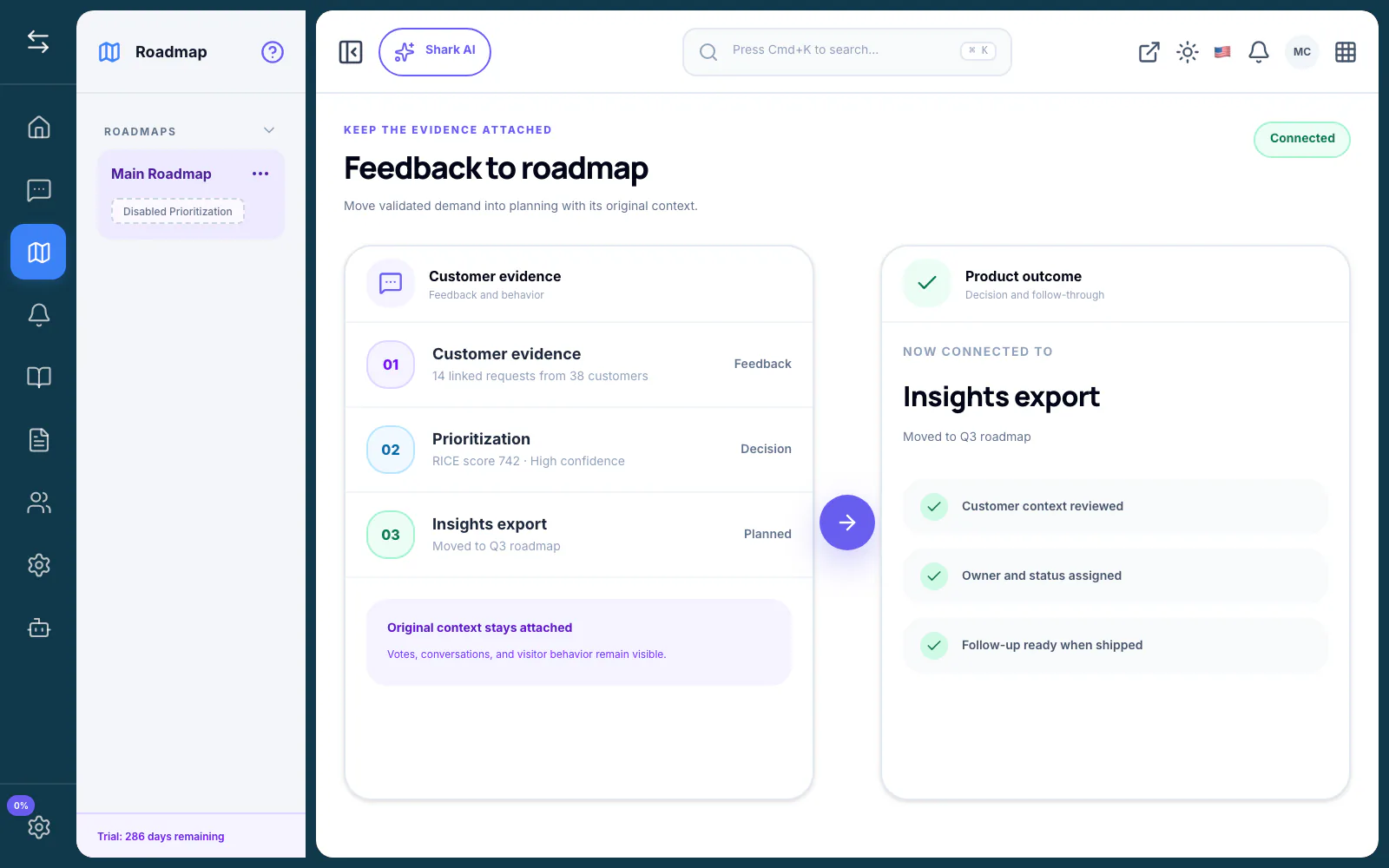
- Connect evidence: Attach customer demand, strategic goals, and operational constraints to each candidate.
- Compare tradeoffs: Use one consistent framework while keeping judgment visible.
- Choose and sequence: Limit work in progress and state why selected items come before alternatives.
- Review openly: Update the roadmap when evidence changes and communicate the reason.
What Should You Measure?
Track whether the practice improves the decision and the follow-through—not whether the team simply produced more activity. Useful measures can include review time, duplicate rate, decision lead time, adoption, support volume, response rate, and the percentage of customers who receive a meaningful update.
Define the baseline and timeframe before changing the process. Segment results where customer type or workflow maturity could change the interpretation.
Decision Checklist
Before adopting or changing this approach, confirm that your team can answer these questions:
- What decision will this support? Name the owner and the action that follows.
- Where does the source context live? Keep the customer, use case, and evidence traceable.
- Which parts are repeatable? Automate stable rules, not ambiguous judgment.
- What requires approval? Define where a person must review, edit, or make a commitment.
- How will you know it works? Choose a baseline, timeframe, and small set of outcome measures.
A lightweight process that the team follows is usually more useful than a sophisticated process that is constantly bypassed. Start with the minimum structure needed to make the next decision better, then add detail when repeated problems justify it.
When This Approach Is the Wrong Fit
Do not add a formal system when the underlying problem is unclear ownership, missing strategy, or a team that does not review the evidence it already has. New tooling cannot replace an explicit decision-maker or a willingness to communicate tradeoffs.
It may also be too early when the workflow happens rarely and manual handling is still fast, visible, and reliable. Document the process first. Add automation after the team can describe the stable steps and exceptions.
Common Mistakes
- Publishing dates before delivery confidence exists.
- Using votes as the only prioritization signal.
- Mixing strategic outcomes with an engineering task list.
- Leaving old items visible without a clear status or explanation.
Frequently Asked Questions
When should a team start using roadmap tools?
Start when the cost of scattered context, repeated discussion, or manual follow-up is affecting decisions. Begin with one workflow and a clear owner before adding automation.
Should the process be automated?
Automate collection, routing, deduplication, summaries, and drafts where the rules are clear. Keep prioritization, customer commitments, and consequential publishing decisions under human review.
How often should the workflow be reviewed?
Review operational queues weekly and revisit the process itself at least quarterly. Change it sooner when ownership, customer segments, integrations, or company priorities shift.
What is the simplest way to begin?
Choose one high-friction use case, document the current steps, set one success measure, and run the new approach with a small group before expanding it.
Bottom Line
Compare the top roadmap tools for product managers. Features, pricing, and use cases for each platform. The strongest implementation is explicit about its decision, preserves source context, and gives the team a repeatable way to review evidence and communicate what happens next.
Related Guides
- FeatureShark vs Featurebase: Per-Seat Pricing vs Flat Rate — Which Feedback Platform Wins in 2026?
- FeatureShark vs UserVoice: Enterprise Pricing vs Startup-Friendly Feedback in 2026
- FeatureShark vs Productboard: Why Pay Enterprise Prices for Feedback Management in 2026?
- Canny vs FeatureShark: Which Feedback Tool is Right for Your Budget in 2025?
Sources and Further Reading
About this article
Written by FeatureShark Team
FeatureShark publishes practical product-management guidance based on the workflows we build for feedback, roadmaps, changelogs, support, surveys, and AI-assisted product operations. We update articles when the underlying guidance changes.
Put the workflow into practice.
Use FeatureShark to connect customer feedback, roadmap evidence, release communication, support, and surveys in one lifecycle.
Start free